
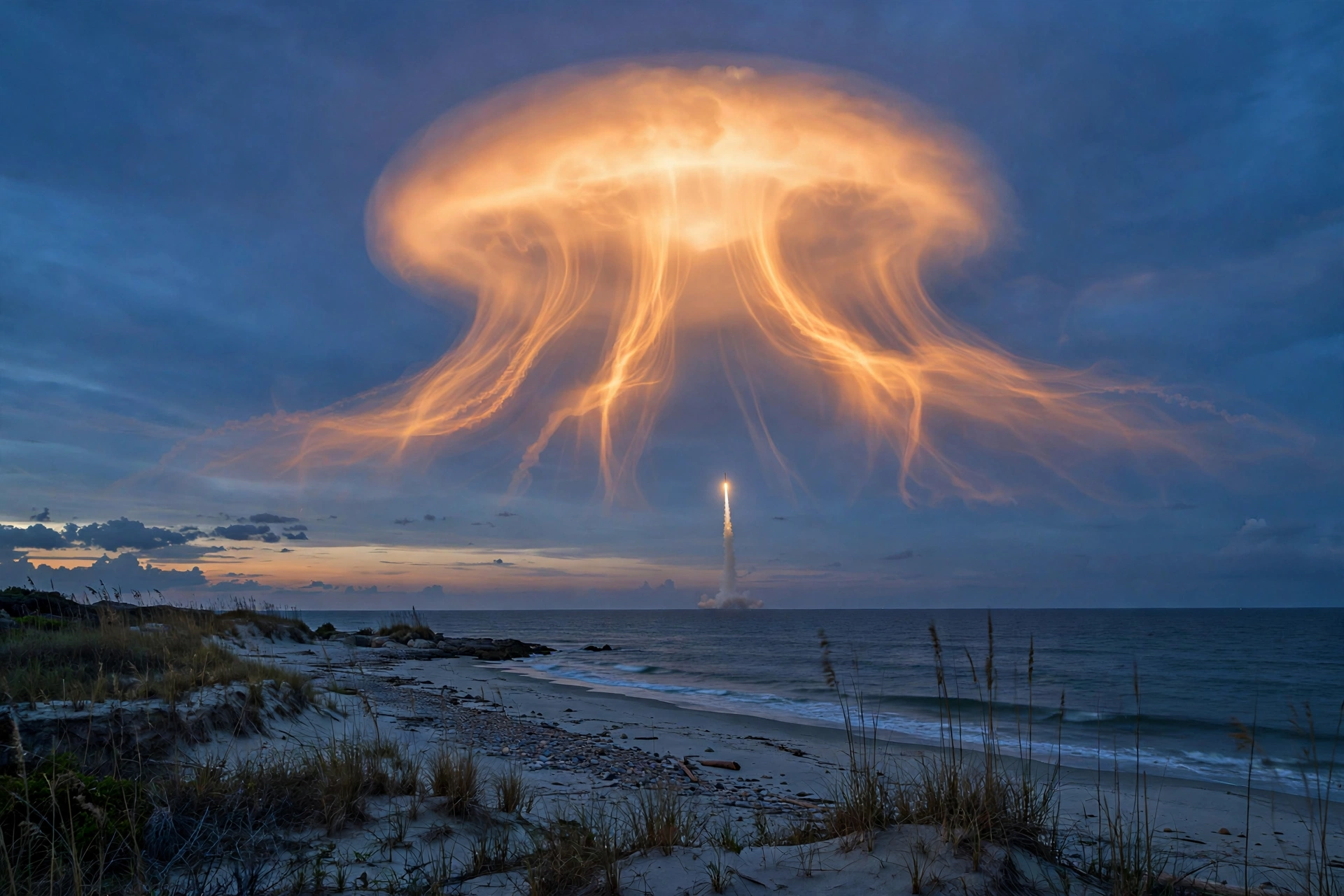
Skywatchers along the United States East Coast were treated to an unusual and beautiful sight this week when a SpaceX rocket launch produced a glowing, jellyfish-shaped cloud high in the upper atmosphere. Photographs shared from coastal communities showed a bright, expanding plume with soft, trailing tendrils, hanging in the twilight sky long after the rocket itself had disappeared from view. The phenomenon, often called a space jellyfish, is one of the most striking visual side effects of modern rocket launches, and this latest display quickly became a talking point far beyond the space community.
What Exactly Is a Jellyfish Cloud?
A jellyfish cloud forms when a rocket climbs into the thin upper atmosphere during the twilight hours, either shortly before sunrise or shortly after sunset. On the ground, the sky may already be dark, but at high altitude the rocket’s exhaust plume is still illuminated by sunlight. The plume expands rapidly in the low-pressure environment, spreading into a broad, rounded bulb with wispy trails beneath it. Viewed from below, the glowing structure closely resembles a jellyfish drifting across the sky, complete with a bright dome and trailing tentacles.
The effect depends on a precise combination of timing, altitude and atmospheric conditions. Launches that take place in the middle of the day or deep in the night rarely produce the same display, because the exhaust is either lost in bright daylight or remains unlit. Twilight launches, by contrast, create a dramatic contrast between the darkening sky and the sunlit plume, which is why photographers and space enthusiasts watch launch schedules so closely for these windows.
Why This Launch Caught So Much Attention
Several factors helped this particular display reach such a wide audience. The launch was visible from a long stretch of coastline, where millions of people live within sight of the eastern sky. Clear weather in many areas meant the plume was not hidden behind ordinary clouds, and the twilight timing made it bright enough to be captured clearly on ordinary phone cameras. Within a short time, images of the glowing formation were circulating widely, with many onlookers initially unsure what they were seeing.
Reports of the display were covered by major outlets, including The Guardian, which described the stunning cloud visible off the US east coast. For space agencies and launch providers, moments like these are an unexpected public-relations gift: a routine mission briefly becomes a shared public spectacle that reminds people how active the modern launch industry has become.
A Sign of a Busier Launch Era
Displays like this are becoming more common simply because launches are becoming more frequent. SpaceX now flies missions at a pace that would have been unthinkable a generation ago, supporting commercial satellites, government payloads and its own Starlink broadband network. Each additional twilight launch is another chance for coastal residents to see the jellyfish effect, and seasoned observers in Florida and neighbouring states have learned to recognise it instantly.
The growing launch cadence is also driving rapid progress in related technology. Readers interested in how innovation is reshaping everyday life may enjoy our recent coverage of solid-state batteries and what they mean for electric cars, another field where years of research are suddenly becoming visible in the real world.
How to Catch the Next One
For anyone hoping to witness a jellyfish cloud in person, the recipe is straightforward. Look for launches scheduled in the hour before sunrise or the hour after sunset, choose a viewing spot with a clear view toward the launch site, and be ready to look up in the first few minutes after liftoff. The plume usually becomes most visible as the rocket gains altitude, and the display can last several minutes before the exhaust disperses. Binoculars are not necessary, although they can reveal structure in the trailing tendrils.
It is also worth remembering that launch schedules change frequently because of weather and technical checks. Checking for updates on the day itself, and arriving early, greatly improves the odds of seeing the show. Even experienced observers say the sight remains startling: a silent, glowing organism of light blooming in a darkening sky.
A Reminder of Why Launches Captivate Us
Beyond the science, the appeal of the jellyfish cloud is simple wonder. Most people experience spaceflight through screens, statistics and mission updates. A twilight plume turns an abstract event into something anyone can see with the naked eye, simply by stepping outside. This week’s SpaceX display gave the East Coast exactly that kind of moment, and as launch schedules grow busier, it is unlikely to be the last one this year.
