
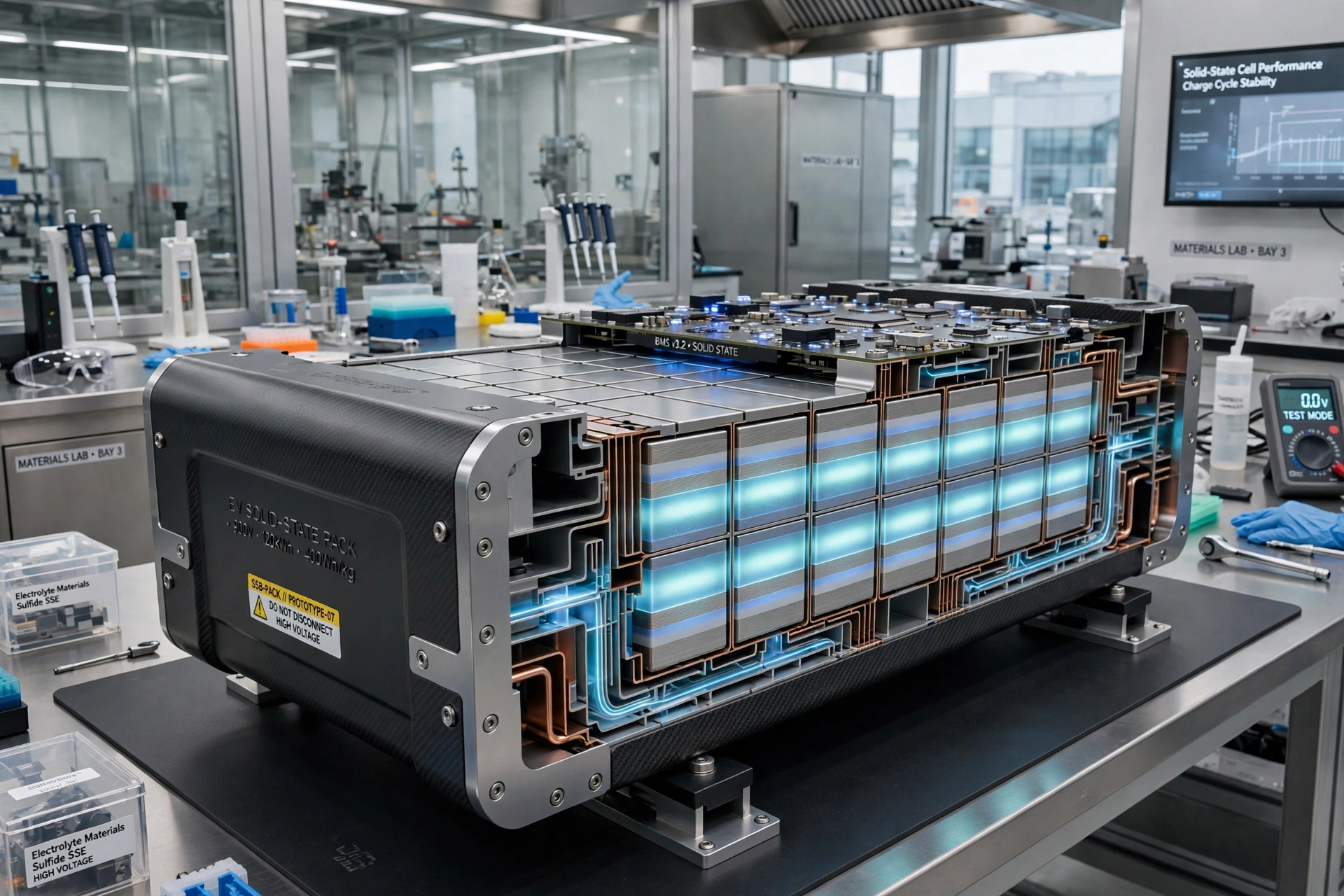
For more than a decade, solid-state batteries have been the electric car industry’s favourite promise: a technology always five years away that would double driving range, slash charging times and remove the fire risk of today’s lithium-ion cells. The joke is wearing thin — in a good way. Pilot factories are running, prototype vehicles are testing on real roads, and the first commercial cells are beginning to ship in small volumes.
The difference from a conventional battery is in the name. Today’s cells shuttle lithium ions through a liquid electrolyte, which is flammable and limits how much energy can be packed in safely. A solid-state cell replaces that liquid with a ceramic or sulphide solid, unlocking the use of lithium-metal anodes that store far more energy in the same space.
Why it has taken so long
The physics was never the main problem; the manufacturing is. Solid electrolytes are brittle, they crack under the swelling and shrinking of charge cycles, and tiny metallic filaments called dendrites can pierce them and short the cell. Making defect-free ceramic layers at the speed and scale of a gigafactory — millions of cells, near-zero failures — has consumed billions in research funding.
Progress has come in stages. Semi-solid designs, which use a gel-like intermediate material, are already on the road in some Chinese models and offer modest gains. Full solid-state cells from the major developers — Toyota, Samsung SDI, QuantumScape and a pack of Chinese champions — are now in pilot production, with mass-market timelines clustered around the end of the decade. The International Energy Agency tracks the race closely, noting that battery innovation remains the single biggest lever on EV cost and appeal.
What drivers would actually notice
Strip away the chemistry and the consumer promise is simple. Range anxiety fades when a family car can travel 800 to 1,000 kilometres on a charge. Charging stops shrink toward the length of a coffee break. Cars get lighter, or keep their range with a smaller, cheaper pack. And because there is no flammable liquid, safety improves — a benefit insurers and regulators both appreciate.
The caveats deserve equal billing. Early solid-state cells will be expensive and will debut in premium models, exactly as lithium-ion did. Claims from laboratories do not always survive contact with mass production, and the incumbent technology is a moving target: conventional cells keep getting cheaper and better every year. Research coverage in journals such as Nature reflects this mixture of genuine excitement and hard-won caution.
The road ahead
The likeliest future is not a sudden flip but a cascade: flagship EVs first, then performance models, then the mainstream, over the early 2030s — with conventional batteries dominating budget segments for years beyond that. Grid storage and aviation are watching too, since both prize energy density.
A genuinely global race
The competition has a geopolitical edge. Japan has backed its champions with substantial public funding and holds a deep patent lead; South Korea’s battery giants are racing to match them; China, already dominant in conventional cells, is pouring resources into both semi-solid products shipping today and full solid-state designs for tomorrow. American and European startups, meanwhile, licence their technology to carmakers rather than building factories alone.
Governments care because batteries sit at the junction of industrial policy, energy security and climate targets. Whoever manufactures the best cells at scale captures a commanding position in the car industry of the next thirty years. That strategic weight explains why timelines in this field are announced with such fanfare — and why each delay is reported like a diplomatic incident.
What has changed is the burden of proof. Solid-state batteries no longer need to demonstrate that they work; they need to demonstrate that they can be built by the million, at a price the market will pay. On the evidence of the pilot lines now running, that demonstration is well under way. For more technology coverage, read Single Topic News.
