
Casino marketing is built around one large number: the size of the welcome bonus. Buried several screens further down, in the payments page or the general terms, sits a far smaller and far more consequential figure, the withdrawal limit. It dictates how much of a win a player can actually move to a bank account in a day, a week or a month, and in some cases how much of a bonus-funded win can ever be cashed out at all. As Finnish players have grown accustomed to withdrawals that arrive in minutes, comparison services report that limits have quietly become one of the most scrutinised items in the small print. This explainer looks at what the limits are, why they exist, and how to read them before depositing.
What a withdrawal limit actually is
A withdrawal limit is a cap on the amount a player can take out of a casino account within a set period. It appears in several forms, and a single casino may apply more than one at once:
- Per-transaction limits set the maximum for one withdrawal request. A large win may need to be split into several requests.
- Daily, weekly and monthly limits cap the total paid out over a period. A five-figure win at a casino with a modest monthly cap could take many months to receive in full.
- Minimum withdrawal amounts work in the opposite direction, preventing very small balances from being cashed out.
- Bonus-related caps restrict how much of a win generated from bonus funds can be withdrawn, with the excess removed when the bonus is settled.
- Jackpot exemptions sometimes apply, with progressive jackpot wins paid outside the normal schedule, though this is not universal.
Each of these can be perfectly reasonable in isolation. The problem for players is that they interact, and that the combined effect is rarely spelled out on the promotional page where the bonus is advertised.
Why limits exist at all
Operators cite several reasons for capping withdrawals. Cash-flow management is the most straightforward: a casino holding a large number of player balances needs predictable outflows, particularly a smaller operator. Fraud and money-laundering controls are another, since staggered payouts give compliance teams time to review unusual activity. Payment-rail constraints also play a part; a card refund to Visa or Mastercard may be subject to the issuer’s own ceilings, and some e-wallets impose their own transaction maximums. And, less charitably, a tight withdrawal cap keeps money inside the casino environment for longer, where it is more likely to be wagered again.
None of this is hidden from regulators. Licences from EU jurisdictions such as Malta and Estonia permit withdrawal limits, provided they are disclosed in the terms. The onus therefore falls on the player to find and read them.
Why the number matters more than the bonus
Consider the way a typical welcome offer is presented: a match bonus on the first deposit, often with free spins attached. The figure in large type is the maximum bonus amount. A player who deposits to claim it accepts wagering requirements, usually expressed as a multiple of the bonus or of the bonus plus deposit, along with a maximum bet per spin while the bonus is active. Those terms determine whether the bonus can realistically be converted to withdrawable cash at all.
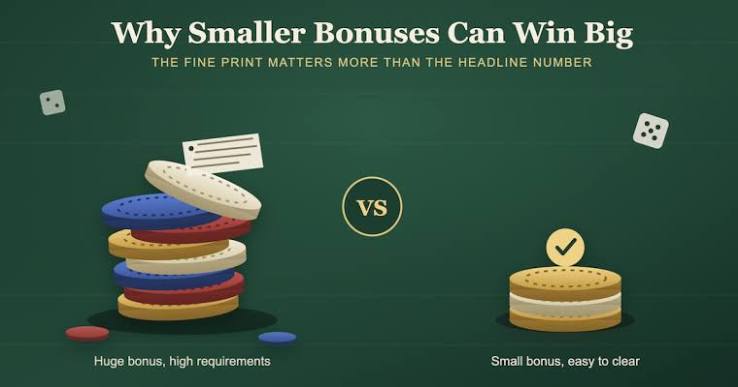
But even a player who clears the wagering requirement then runs into the withdrawal rules. Some operators cap the amount that can be withdrawn from bonus winnings at a few multiples of the original bonus. Others apply their standard daily or monthly limits, which may be low relative to the size of the win. The result is a mismatch: the bonus promises a large upside, the limits ensure the realised upside is small or slow. Comparison services in Finland have for some time argued that wagering requirements and withdrawal limits, taken together, say more about an offer’s real value than its headline size, and that a smaller bonus with light wagering and generous limits almost always serves a player better.
Speed and limits are not the same thing
Finland’s casino market has reorganised itself around payout speed. The Finnish phrase Nopea kotiutus kasino (fast-withdrawal casino) has become one of the most common ways players look for a site, and the technology behind the speed is now well understood: Pay N Play log-in via bank identification replaces registration, and open-banking withdrawals through providers such as Trustly or Zimpler can land in a Finnish bank account within minutes. Card withdrawals usually take one to three business days, and e-wallets such as Skrill or Neteller typically sit somewhere in between.
Speed, however, describes how quickly an approved withdrawal moves. It says nothing about how much can be moved. A casino can genuinely pay out in under five minutes and still restrict a player to a modest weekly cap, meaning a larger win is paid in instalments, each one fast but the whole process slow. Comparison sites that measure payout times increasingly report the limits alongside the speed for exactly this reason. A player searching for a fast casino should be asking two questions, not one: how quickly does the money arrive, and how much of it can arrive at once?
Reading the limits before depositing
A few practical habits help:
- Find the payments or banking page and the general terms. Limits are often listed in one, the bonus caps in the other, and the two should be read together.
- Note whether the limit is per transaction, per day, per week or per month, and whether it is per account or per payment method. Open-banking withdrawals sometimes carry different ceilings from card withdrawals.
- Check whether verified or long-standing accounts receive higher limits. Many operators raise caps after identity checks are complete, which is one more reason to finish KYC early rather than at the moment of a first large withdrawal.
- Look specifically for a maximum cash-out from bonus winnings, and compare it to the wagering requirement. A high requirement paired with a low cash-out cap is the combination most likely to disappoint.
- Consider the ratio between your typical stake and the limit. A player who only ever deposits small amounts may never encounter a monthly cap; a player chasing larger wins almost certainly will.
Where the terms are vague, or the limit is impossible to find, treat that as information in itself. Operators licensed in the EU or EEA are required to disclose such terms, and an evasive answer from support is a reason to look elsewhere.
Limits, tax and licence
For Finnish players the licence behind a casino interacts with limits in an indirect but important way. Winnings from operators licensed in the EU or EEA, such as under the Malta Gaming Authority or Estonia’s regulator, are generally tax-free for Finnish residents; winnings from operators licensed outside the EU and EEA, for instance in Curaçao, are taxable. A low withdrawal cap at a taxable casino therefore stretches a win across several tax periods as well as several payment runs, complicating the player’s own record-keeping. Finland is moving toward a licensing model for its gambling market, and observers expect domestic rules to address disclosure of payment terms, but until then the responsibility to read and compare rests with the player.
It is also worth distinguishing operator-imposed limits from player-set limits. Deposit limits, loss limits and session-time limits that a player configures in the account are responsible-gambling tools, and they work in the player’s favour. Online casino play is for adults aged 18 and over and should be treated as entertainment with a fixed cost, never as a way to earn money. Setting a budget before playing, using the account’s limit tools, and knowing that self-exclusion and independent blocking services are available for anyone who needs a firmer brake are sensible habits regardless of how generous an operator’s withdrawal terms may be.
The role of comparison services
Because limits are scattered across terms pages and rarely advertised, independent comparison has become the practical way to assess them. Services such as Kotiuta publish measured withdrawal times alongside notes on wagering requirements, licence and tax status, and increasingly flag the withdrawal caps that determine how a fast payout translates into money actually received. For a player, the useful mental model is a filter: start with speed and licence, then rule out any site whose limits would make a realistic win impractical to collect, and only then look at what bonus, if any, is on offer.
Conclusion
The bonus is the number a casino wants a player to see; the withdrawal limit is the number a player needs to see. In a market where open-banking payouts arrive in minutes and bank identification has made signing up effortless, the remaining friction has moved into the small print. A limit that is reasonable, clearly disclosed and consistent with the bonus terms is a sign of an operator that intends to pay. A limit that is hidden, unusually low or paired with heavy wagering is a sign that the large number at the top of the page was never meant to be withdrawn in full. Reading that small-print number first, before the deposit rather than after the win, is the simplest protection a player has.
